
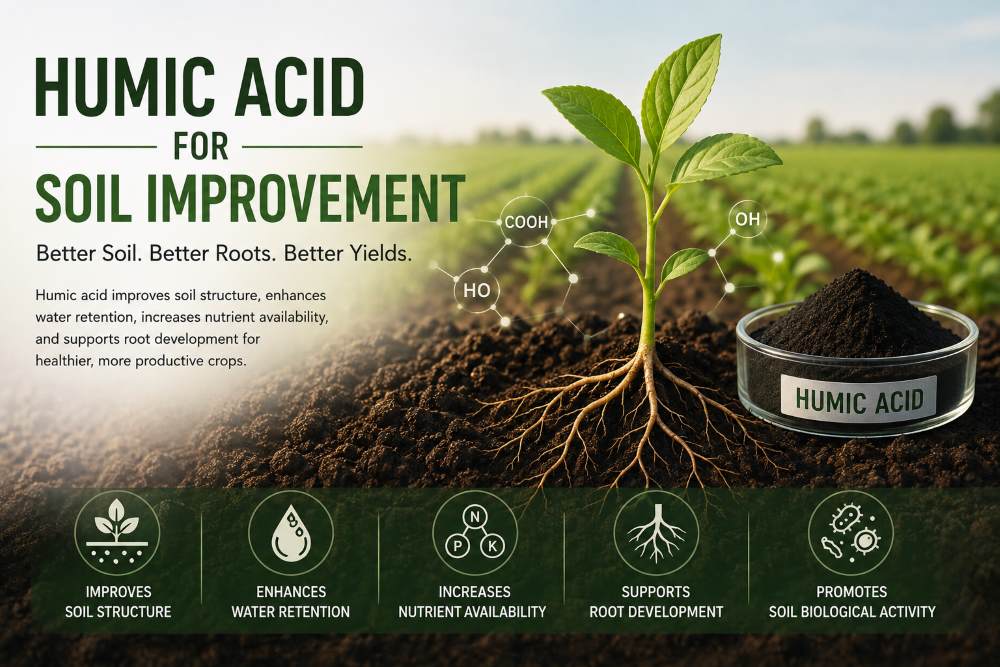
How Humic Acid Supports Soil Improvement
Healthy soil is the foundation of productive and sustainable agriculture. However, intensive cultivation, low organic matter, poor soil structure, nutrient loss, and limited water availability can gradually reduce soil performance. These challenges can affect root development, nutrient uptake, water efficiency, and ultimately crop productivity.
Humic acid is a naturally occurring component of humic substances formed through the long-term decomposition and transformation of organic matter. In agriculture, humic acid is widely used as a soil conditioner and as an ingredient in fertilizers and soil-management products.
Humic acid does more than supply components to the soil. It can influence several important properties of the soil environment. It may support soil aggregation, improve nutrient retention and availability, contribute to better water management, and create more favorable conditions around the root zone. These properties make humic acid particularly relevant to modern soil improvement strategies.
Understanding how humic acid interacts with different soils is important, however. Its effectiveness can depend on factors such as soil texture, organic matter content, pH, application method, product quality, and crop requirements. For this reason, humic acid should be considered as part of an integrated soil and plant nutrition program rather than a universal solution to every soil problem.
What Does Soil Improvement Actually Mean?
Soil improvement aims to create better conditions for plant growth. It focuses on the physical, chemical, and biological properties of soil. The objective is not simply to add more fertilizer. Soil improvement helps the soil store water, retain nutrients, and support healthy roots. It also helps maintain a productive growing environment over time.
Several characteristics are particularly important when evaluating soil quality:
Soil Structure
Good soil structure allows soil particles to form stable aggregates rather than remaining excessively compacted or loose. This influences aeration, water movement, root penetration, and resistance to erosion. Improving soil structure can therefore create a more favorable environment for root development.
Water Retention
The ability of soil to retain and make water available to plants is especially important in dry climates and soils with low water-holding capacity. Improving water retention can help maintain moisture around the root zone and improve the efficiency of irrigation.
Nutrient Availability
Applying nutrients does not necessarily mean that plants can efficiently use them. Nutrients may be lost through leaching, become chemically unavailable, or move beyond the active root zone. Effective soil management aims to improve nutrient retention and availability, supporting more efficient plant nutrition.
Root Environment
Healthy roots require an appropriate balance of moisture, oxygen, nutrients, and suitable soil structure. Improving conditions in the rhizosphere—the area of soil directly influenced by plant roots—can support stronger root development and more efficient use of available resources.
Biological Activity
Soil is a living ecosystem containing microorganisms involved in organic matter decomposition and nutrient cycling. Maintaining favorable physical and chemical conditions can help support the biological processes that contribute to long-term soil health.
For this reason, soil improvement should be viewed as a combination of better structure, efficient water management, improved nutrient availability, healthy root conditions, and biological functionality. Humic substances, including humic acid, are used in agricultural soil-management programs because of their potential to influence several of these properties simultaneously.
In the following sections, we will examine how humic acid interacts with soil and how these interactions can contribute to improved soil performance in different agricultural conditions.
What Is Humic Acid and How Does It Work in Soil?
Humic acid is a naturally occurring fraction of humic substances, a complex group of organic compounds formed during the long-term decomposition and transformation of plant and other organic materials. It is commonly found in soils, peat, and highly humified materials such as leonardite, which is widely used as a raw material for commercial humic products.
In agriculture, humic acid is valued primarily for the way it interacts with the soil environment. Unlike conventional fertilizers that mainly supply specific nutrients, humic acid can influence the physical and chemical conditions that determine how effectively soil stores water, retains nutrients, and supports plant roots.
Its structure contains multiple functional groups that can interact with mineral surfaces and positively charged nutrient ions. These properties help explain why humic acid is widely used in soil improvement programs and soil-conditioning products.
The effects of humic acid are not based on a single mechanism. Instead, several processes can occur simultaneously, including interactions with soil particles, nutrient retention, and changes in conditions around the root zone.
Interaction with Soil Particles
One of the most important roles of humic acid in soil is its interaction with mineral and organic particles. These interactions can contribute to the formation and stabilization of soil aggregates—groups of smaller soil particles that bind together into larger structural units.
Stable aggregation is important because soil structure directly affects water movement, aeration, drainage, and root penetration. A well-structured soil contains a balance of pore spaces that allow both air and water to move through the root zone.
The effect can be particularly relevant where soil structure limits agricultural performance. In coarse-textured soils, humic acid can support water and nutrient retention. In finer-textured soils, better aggregation can improve soil structure. This can support water movement, aeration, and root development.
For this reason, humic acid is frequently incorporated into soil conditioner formulations designed to improve the overall growing environment rather than simply supply nutrients.
Nutrient Retention and Availability
Effective plant nutrition depends not only on how much fertilizer is applied but also on how nutrients behave after entering the soil.
Humic substances contain negatively charged functional groups capable of interacting with positively charged nutrient ions such as potassium, calcium, magnesium, iron, and other micronutrients. Through these interactions, humic acid can contribute to the soil’s ability to retain nutrient ions and influence their availability within the root zone.
This is particularly important in soils where nutrients are easily lost through leaching or become less available because of soil chemistry. Better nutrient retention can help keep valuable elements within the active root zone for longer periods, potentially improving fertilizer-use efficiency.
Humic acid can also form complexes with certain micronutrients, influencing their mobility and availability in soil. However, these effects depend on soil pH, mineral composition, nutrient source, humic product characteristics, and environmental conditions.
Therefore, humic acid should not be considered a replacement for a balanced fertilizer program. Instead, it can serve as a complementary component of plant nutrition and soil-management strategies aimed at improving how efficiently the soil retains and supplies nutrients.
Supporting the Root Zone
The root zone, or rhizosphere, is one of the most important areas in the soil–plant system. It is where roots interact with water, nutrients, soil particles, organic compounds, and microorganisms.
By supporting soil structure, moisture management, and nutrient availability, humic acid can contribute to creating more favorable conditions around developing roots. Better soil aggregation can facilitate root penetration, while improved water and nutrient retention can help maintain resources where plants can access them.
Humic substances have also been studied for their direct and indirect effects on root development and nutrient uptake. The magnitude of these responses, however, can vary considerably depending on crop species, soil conditions, product composition, concentration, and application method.
For growers and fertilizer formulators, this is an important distinction: the value of humic acid is not simply the amount of material applied, but how the product interacts with the specific soil and cropping system.
When incorporated appropriately into a broader soil-management program, humic acid can therefore support a healthier root environment and contribute to more efficient use of water and nutrients—two important components of long-term soil improvement.
Key Benefits of Humic Acid for Soil Improvement
Humic acid can contribute to soil improvement through several interconnected mechanisms. Its benefits are associated with changes in soil structure, water and nutrient management, root-zone conditions, and biological activity. The actual response can vary depending on soil type, crop, climate, application rate, and the characteristics of the humic product used.
1. Improving Soil Structure
Soil structure plays an important role in determining how easily water, air, and plant roots can move through the soil. Poorly structured soils may become compacted, restrict root penetration, or allow water and nutrients to move through the profile inefficiently.
Humic acid can interact with mineral particles and contribute to the formation and stability of soil aggregates. Better aggregation can create a more favorable distribution of pore spaces, supporting aeration, water movement, and root penetration.
These properties are one reason humic acid is commonly used as a soil conditioner in agricultural soil-management programs. Rather than simply adding nutrients, it can help improve the physical environment in which plants develop.
2. Supporting Water Retention
Efficient water management is increasingly important in agriculture, particularly in dry regions and in soils that have limited capacity to hold moisture.
Humic substances can contribute to the soil’s ability to retain moisture by influencing soil aggregation and organic interactions within the soil matrix. This can be particularly valuable in sandy and coarse-textured soils, where water can drain rapidly beyond the active root zone.
Improved water retention may help maintain a more stable moisture environment around plant roots and make irrigation water available for longer periods. However, the magnitude of this benefit depends strongly on soil texture, organic matter content, climate, irrigation practices, and application conditions.
Humic acid should therefore be considered part of an integrated water and soil-management strategy rather than a substitute for appropriate irrigation practices.
3. Improving Nutrient Availability
Efficient plant nutrition depends on more than the amount of fertilizer applied. Nutrients must remain within the root zone and in forms that plants can access.
Humic acid contains functional groups capable of interacting with nutrient ions and mineral surfaces. These interactions can influence the retention, mobility, and availability of nutrients such as potassium, calcium, magnesium, iron, and other micronutrients.
By helping retain certain nutrients within the soil system, humic substances may reduce their susceptibility to loss under some conditions and support more efficient nutrient management. They can also interact with micronutrients through complex formation, potentially influencing their availability to plants.
This does not mean that humic acid replaces fertilizers. Instead, it can complement a balanced fertilization program by supporting the soil processes involved in nutrient retention and availability.
4. Supporting Root Development
A healthy root system allows plants to explore a greater volume of soil for water and nutrients. Root development is therefore closely connected to soil structure, moisture availability, aeration, and nutrient conditions.
By contributing to improved physical and chemical conditions in the root zone, humic acid can support an environment favorable to root growth. Research on humic substances has also reported physiological responses associated with root development, although these responses vary according to the source and composition of the humic material, concentration, crop species, and growing conditions.
A stronger and more extensive root system can improve a plant’s ability to access available resources. This makes root-zone management an important link between the use of humic substances and overall soil performance.
5. Supporting Soil Biological Activity
Healthy agricultural soil is a biologically active ecosystem. Bacteria, fungi, and other soil organisms participate in organic matter decomposition, nutrient cycling, and many processes that influence soil fertility.
Humic substances form part of the organic environment in which these biological processes occur. By contributing to soil organic matter interactions and improving physical conditions such as aggregation, moisture, and aeration, humic acid may help create a more favorable environment for beneficial soil microbial activity.
The relationship between humic substances and soil biology is complex and depends on many environmental factors. For this reason, humic acid should not be viewed as a direct replacement for organic matter management or other practices that support soil biodiversity.
Instead, its use can form part of a broader sustainable agriculture strategy that combines appropriate fertilization, water management, organic matter conservation, and responsible soil management to maintain productive soils over the long term.
Looking for High-Quality Humic Acid?
Discover SAVENA NOVA Humic Acid Powder, developed for agricultural applications and professional fertilizer formulations. Explore product details, available packaging options, and supply solutions for your business.
Humic Acid as a Soil Conditioner
A soil conditioner is a material used to improve the physical, chemical, or biological properties of soil rather than simply supplying nutrients directly to plants. Humic acid is widely used for this purpose because it can interact with both soil particles and nutrient ions, influencing several factors that determine soil performance.
One of its most important roles is supporting soil structure. Humic substances can contribute to the formation and stability of soil aggregates, which can improve pore distribution, aeration, water movement, and conditions for root penetration. These effects are particularly relevant when poor structure limits the ability of soil to support healthy plant growth.
Humic acid can also contribute to nutrient management. Its functional groups can interact with positively charged nutrient ions, helping influence their retention and availability within the soil. This can complement fertilizer programs by supporting a more favorable environment for nutrient use rather than simply increasing the amount of nutrients applied.
Another important aspect of soil conditioning is moisture management. By influencing soil structure and organic interactions within the soil matrix, humic substances can contribute to water retention and help maintain more favorable moisture conditions in the root zone.
For these reasons, humic acid can be incorporated into broader soil improvement programs where the objective is to improve soil performance over time. However, it should not be considered a universal replacement for fertilizers, organic amendments, irrigation management, or other agronomic practices. The best results generally come from selecting an appropriate humic product and integrating it with a soil-management strategy based on actual soil conditions.
Does Humic Acid Work the Same in Every Soil?
No. The effects of humic acid can vary considerably between soils. Soil texture, pH, organic matter content, mineral composition, salinity, climate, crop type, irrigation practices, application method, and the characteristics of the humic product can all influence the response.
Understanding these differences is important when deciding how humic acid should be incorporated into a soil-management program.
Sandy Soils
Sandy soils contain relatively large particles and typically have high drainage rates. As a result, they may have limited capacity to retain water and nutrients within the active root zone.
In these conditions, humic substances can be particularly useful as part of a strategy aimed at improving moisture and nutrient management. Their interactions with soil particles and nutrient ions may help support water retention and reduce the rapid movement of certain nutrients through the soil profile.
Clay and Fine-Textured Soils
Clay-rich soils generally retain more water and nutrients than sandy soils, but they may present different challenges, including poor aeration, slow drainage, compaction, and restricted root penetration.
In these soils, the value of humic acid is more closely related to its potential contribution to soil aggregation and structural improvement. Better aggregation can help create a more favorable balance between water retention, drainage, aeration, and root development.
Soils with Low Organic Matter
Soils with depleted organic matter often have poorer structure, reduced nutrient-retention capacity, and less favorable conditions for biological activity.
Humic substances can contribute organic functional components that interact with minerals and nutrients in these soils. However, applying humic acid should not be viewed as a complete substitute for building soil organic matter through practices such as crop-residue management, compost application, cover cropping, or other appropriate organic amendments.
Salinity-Affected Soils
Saline and sodic soils require particularly careful management because excessive soluble salts or sodium can negatively affect soil structure, water availability, nutrient balance, and plant growth.
Humic substances are sometimes incorporated into management programs for salt-affected soils, particularly alongside appropriate irrigation, drainage, nutrient management, and—in sodic soils—suitable amendments. Their effectiveness depends strongly on the specific soil problem and should therefore be evaluated according to soil analysis rather than assumed from a general application recommendation.
| Soil Type | Common Challenge | Potential Role of Humic Acid |
| Sandy soil | Low water and nutrient retention | Support moisture and nutrient retention |
| Clay soil | Compaction and poor aeration | Support aggregation and soil structure |
| Low-organic-matter soil | Poor structure and nutrient-retention capacity | Complement broader organic matter and soil-improvement strategies |
| Salinity-affected soil | Salt-related structural and nutrient problems | Complement an integrated salinity-management program |
The key point is that humic acid should be matched to the soil rather than applied with the expectation of the same response everywhere. Soil testing, crop requirements, product composition, and local growing conditions should guide product selection and application.
This soil-specific approach allows humic acid to be used more effectively as a soil conditioner and as one component of a broader strategy for long-term soil improvement.
Need Humic Acid for Your Business?
Whether you are a fertilizer manufacturer, agricultural distributor, importer, or private-label brand, SAVENA NOVA can support your business with humic acid products, flexible packaging, and international supply solutions.