
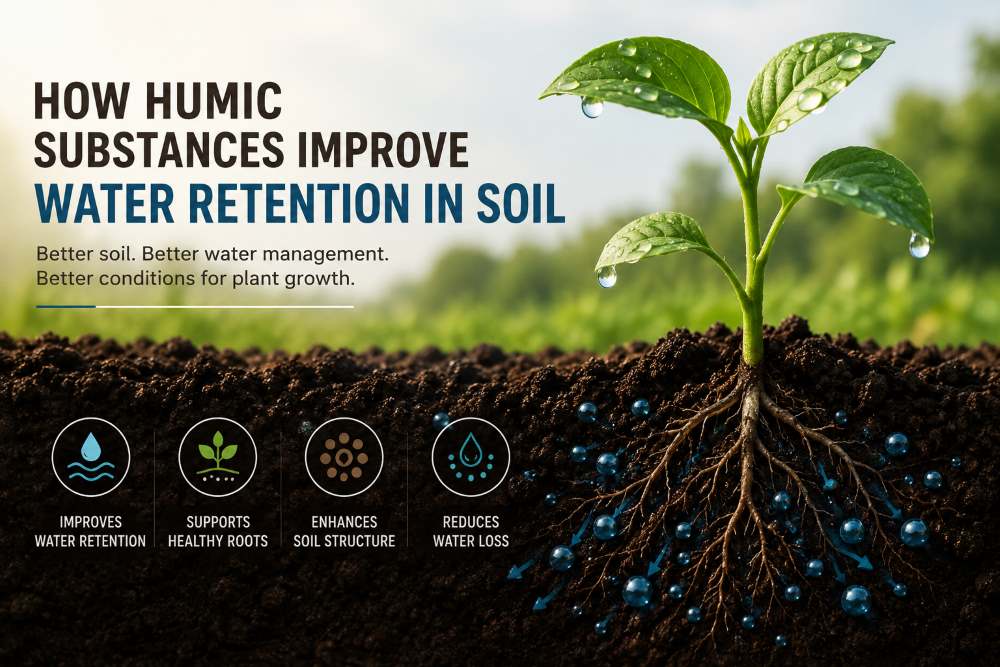
How Humic Substances Improve Water Retention in Soil
Water retention plays a critical role in healthy soil and productive agriculture. Soil must hold enough moisture to support plant growth while still allowing excess water to drain. However, sandy texture, low organic matter, poor soil structure, and intensive cultivation can reduce the soil’s ability to retain moisture. As a result, plants may experience water stress more quickly, and growers may need to irrigate more frequently.
Humic substances can support better soil moisture management. These naturally occurring organic compounds interact with soil particles and influence soil structure. As soil structure improves, the soil can create a more favorable balance between water storage, drainage, and aeration.
Humic acid represents one of the major fractions of humic substances. Farmers and agricultural professionals commonly use it in soil conditioners and fertilizer formulations. Its interactions with soil particles can support aggregation and help create favorable conditions around plant roots. In addition, these effects can contribute to more efficient use of available soil moisture.
However, humic substances do not affect every soil in the same way. Soil texture, organic matter, climate, irrigation practices, and product characteristics all influence their performance. Therefore, growers should consider humic substances as part of a broader soil and water management strategy.
In this article, we explore how soil retains water, why some soils lose moisture faster than others, and how humic substances can support more effective water management in agriculture.
What Is Water Retention in Soil?
Soil water retention describes the soil’s ability to hold water after rainfall or irrigation. Some of this water drains downward through large pores. However, smaller pores and soil particles retain another portion of the water. Plant roots can then access part of this stored moisture as the soil gradually dries.
Several factors determine how much water a soil can retain. Soil texture has a particularly strong influence. Sandy soils contain large particles and large pore spaces, so water often moves through them quickly. In contrast, soils with finer particles generally hold more water. However, excessive compaction or poor structure can restrict drainage and reduce the amount of water that plants can effectively use.
Organic matter also contributes to moisture management. It supports soil aggregation and helps create a pore structure that balances water storage with drainage and aeration. Therefore, soils with low organic matter may struggle to maintain favorable moisture conditions, especially under hot or dry conditions.
Good water retention does not mean keeping as much water as possible. Instead, healthy soil should store enough plant-available water while allowing excess water to drain and oxygen to reach the roots. This balance creates a healthier root environment and helps plants use available water more efficiently.
For agriculture, effective water retention can become especially important in regions with limited rainfall, high temperatures, or restricted irrigation resources. Improving soil structure and organic interactions can help growers manage available water more effectively. Humic substances can play a supporting role in this process, particularly when growers combine them with appropriate irrigation and soil-management practices.
Why Do Some Soils Lose Water So Quickly?
Soils differ greatly in their ability to store water. While some soils can maintain moisture for relatively long periods, others lose water soon after rainfall or irrigation. Several factors control this behavior, including soil texture, organic matter, soil structure, climate, and irrigation practices.
Soil texture has one of the strongest effects. Sandy soils contain relatively large particles and large pore spaces. Therefore, water can move downward through these soils quickly. This rapid drainage may leave less moisture available in the root zone, especially during hot or dry periods.
In contrast, finer-textured soils usually retain more water because they contain smaller particles and pores. However, higher water retention does not always mean better conditions for plants. Compacted or poorly structured soil may hold water while limiting drainage and aeration. As a result, roots may struggle to access the right balance of water and oxygen.
Organic matter also plays an important role. It contributes to stable soil aggregates and helps create a pore structure that supports both moisture storage and drainage. Consequently, soils with low organic matter may have less favorable conditions for holding plant-available water.
Climate can further increase water loss. High temperatures, low humidity, wind, and strong sunlight can accelerate evaporation from the soil surface. At the same time, actively growing plants remove water from the soil through transpiration. Together, these processes can quickly reduce soil moisture.
Finally, irrigation practices affect how efficiently soil uses water. Applying large amounts of water too quickly may cause runoff or deep drainage. On the other hand, insufficient irrigation may fail to wet the active root zone adequately. For this reason, effective water management requires both appropriate irrigation and good soil conditions.
Understanding why a soil loses water is the first step toward improving its water retention. Growers can then select suitable practices based on the specific limitations of their soil rather than relying on a single solution.
How Humic Substances Support Water Retention
Humic substances can support water retention by improving the conditions that control how water behaves in soil. Their role mainly comes from interactions with soil particles, organic components, and the root-zone environment. Rather than acting as a direct source of water, they can help the soil manage available moisture more effectively.
Improving Soil Aggregation
Humic substances can interact with mineral particles and contribute to the formation of stable soil aggregates. These aggregates influence the size and distribution of pore spaces throughout the soil.
A balanced pore structure helps soil perform two important functions. Larger pores allow excess water to drain and provide oxygen to roots. Meanwhile, smaller pores can retain moisture that plants may use later. Therefore, better aggregation can support a healthier balance between drainage and water storage.
The effect can vary with soil type. In sandy soils, improved interactions between particles and organic components may help support moisture retention. In finer-textured soils, better aggregation may improve structure, aeration, and water movement.
Supporting Soil Moisture Storage
Humic substances contain functional groups that interact with water and soil particles. In addition, their contribution to soil structure can influence how water moves through and remains within the soil matrix.
These properties can help create conditions that support moisture storage, particularly in soils with limited organic matter or low water-holding capacity. However, the result depends on several factors. Soil texture, humic product characteristics, application rate, climate, and existing organic matter can all affect the response.
Therefore, growers should not expect humic substances to produce the same increase in moisture retention under every condition. Instead, they can use them as one component of an integrated soil-management strategy.
Improving the Root-Zone Environment
Effective water management involves more than simply keeping moisture in the soil. Plants must also be able to access that water through a healthy and active root system.
Humic substances can support the root-zone environment by contributing to better soil structure, nutrient availability, and moisture conditions. Improved aggregation can make it easier for roots to explore the soil. At the same time, more favorable moisture conditions can help maintain access to water between irrigation events.
A healthy root zone also requires oxygen. For this reason, excessive water retention can be just as problematic as rapid drainage. The goal is to create soil conditions that balance water storage, drainage, and aeration.
Humic substances can contribute to this balance when growers use them appropriately. However, they work best alongside suitable irrigation practices, organic matter management, and other soil-improvement strategies. Together, these approaches can support more efficient use of available water and create better conditions for plant growth.
Humic Acid and Water Retention
Humic acid can support water retention by improving the way soil interacts with and stores moisture. As an important fraction of humic substances, humic acid contains functional groups that interact with soil particles, minerals, and water. These interactions can help create a more favorable soil environment for moisture management.
One important mechanism involves soil aggregation. Humic acid can support interactions between soil particles and contribute to a more stable soil structure. As a result, the soil can develop a better balance of large and small pores. Larger pores support drainage and aeration, while smaller pores help retain moisture within the root zone.
This effect can be particularly valuable in sandy and coarse-textured soils. These soils often drain rapidly because their large pore spaces allow water to move downward quickly. Humic acid cannot change sandy soil into a different soil type. However, it can support soil-management practices that aim to improve moisture and nutrient retention.
Humic acid may also benefit soils with low organic matter. In these conditions, humic substances contribute organic functional components that interact with the soil matrix. Consequently, they can complement other practices that improve soil structure and moisture management.
However, growers should consider local soil conditions before using humic acid for water management. Soil texture, organic matter, climate, irrigation method, crop type, and product characteristics can all influence the results. Therefore, humic acid works best as part of a broader strategy that combines appropriate irrigation, soil management, and plant nutrition.
For a deeper look at its effects beyond water management, read our guide on [How Humic Acid Supports Soil Improvement].
Can Humic Acid Reduce Irrigation Requirements?
Humic acid may help growers use irrigation water more efficiently under certain conditions, but it does not automatically reduce irrigation requirements. The actual water demand of a crop depends on many factors, including climate, crop type, growth stage, soil properties, rooting depth, and irrigation system.
Humic acid can contribute indirectly by supporting soil structure and moisture retention. If the soil keeps plant-available water in the root zone for longer, plants may have better access to moisture between irrigation events. This effect can become especially relevant in soils that drain quickly or have low organic matter.
However, growers should avoid treating humic acid as a substitute for proper irrigation management. Applying a humic product does not guarantee that a field will require a specific percentage less water. The response can vary widely between locations and growing conditions.
Instead, growers should monitor soil moisture and crop needs when evaluating any change in irrigation frequency or volume. Tools such as soil-moisture sensors, field observations, weather data, and irrigation records can help determine whether a soil-management program improves water-use efficiency.
For example, a grower using humic acid in sandy soil may observe that moisture remains available in the root zone for longer. In that case, soil-moisture measurements can help determine whether the irrigation schedule needs adjustment. This approach provides a more reliable basis for decision-making than reducing irrigation according to a fixed recommendation.
Therefore, the practical goal should not simply be “use humic acid to irrigate less.” A better goal is to improve the soil’s ability to manage available water and then adjust irrigation according to measured soil and crop conditions.
When growers combine humic acid with appropriate irrigation, organic matter management, and good agronomic practices, it can become a useful component of a broader strategy for efficient water management and sustainable agriculture.
Choosing a Humic Product for Water Management
Choosing the right humic product can make a significant difference in a soil and water management program. Products vary in their composition, concentration, solubility, raw material, and intended application. Therefore, growers and agricultural businesses should evaluate more than the product name alone.
Start by checking the humic acid content and product specifications. A reliable supplier should provide clear technical information about the product. Depending on the intended use, this information may include humic acid content, moisture, pH, solubility, and other relevant characteristics.
Solubility becomes especially important when growers plan to use the product through fertigation or drip irrigation. Products for these systems should dissolve appropriately and work with the intended equipment. In contrast, soil application or fertilizer manufacturing may require different product characteristics.
The raw material also deserves attention. Commercial humic products can come from different sources, including highly humified materials such as leonardite. The source and processing method can influence the final composition and properties of the product.
Buyers should also consider the intended application. A product designed for direct soil application may differ from one intended for liquid formulations, fertilizer blending, or other commercial uses. Matching the product to the application can improve both performance and handling.
For commercial buyers, product consistency and documentation are equally important. Before placing a large order, consider reviewing available documents such as a Certificate of Analysis (COA), Technical Data Sheet (TDS), or Safety Data Sheet (SDS). Packaging options, supply capacity, and export support may also matter for distributors and fertilizer manufacturers.
Ultimately, no single humic product fits every water-management program. Growers should consider soil conditions, irrigation systems, crop requirements, and application methods before selecting a product.
Looking for Humic Acid for Agricultural Applications?
SAVENA NOVA supplies Humic Acid Powder for agricultural applications, fertilizer formulations, and commercial buyers. Explore our product options and contact our team to discuss your specifications, packaging requirements, and order volume.
Water Retention and Sustainable Agriculture
Efficient water management plays an important role in sustainable agriculture, especially in regions that face limited rainfall, high temperatures, or increasing pressure on irrigation resources. Improving water retention can help agricultural systems make better use of available moisture while supporting healthy soil and plant development.
However, sustainable water management involves more than simply reducing irrigation. Growers need to deliver the right amount of water at the right time while maintaining healthy soil structure and an active root zone. Soil texture, organic matter, crop requirements, climate, and irrigation technology all influence this balance.
Humic substances can support this approach by contributing to soil structure and moisture management. Better aggregation can help create a balance between pores that store water and pores that provide drainage and aeration. As a result, roots may have access to a more favorable soil environment between irrigation events.
Water management also connects closely with nutrient management. Water carries dissolved nutrients through the soil and toward plant roots. Therefore, excessive drainage can move some nutrients beyond the active root zone. Improving soil conditions that support both moisture and nutrient retention can contribute to more efficient use of agricultural inputs.
Nevertheless, humic substances represent only one part of a sustainable soil-management strategy. Practices such as appropriate irrigation scheduling, organic matter management, mulching, soil testing, crop-specific fertilization, and erosion control can also contribute to long-term soil and water efficiency.
The most effective approach combines these practices according to local conditions. By integrating humic substances with responsible irrigation and soil management, growers can work toward better water-use efficiency while supporting soil health and long-term agricultural productivity.
Frequently Asked Questions
What increases water retention in soil?
Several factors can improve water retention, including soil organic matter, good soil structure, appropriate soil conditioners, and effective irrigation practices. Organic matter helps create stable soil aggregates and supports a better balance between water storage and drainage. Humic substances can also contribute to this process by interacting with soil particles and supporting soil structure.
Does humic acid help soil retain water?
Humic acid can support soil moisture retention by improving soil structure and influencing interactions between soil particles and water. However, the effect varies with soil texture, organic matter content, climate, application method, and product characteristics. Growers should use humic acid as part of a broader soil and water management program rather than as a replacement for proper irrigation.
Which type of soil has the lowest water retention?
Sandy soils generally have lower water-holding capacity than finer-textured soils. Their large particles create larger pore spaces, which allow water to drain quickly. As a result, sandy soils may require more careful irrigation and soil-management strategies to maintain adequate moisture in the root zone.
How can growers improve water retention in sandy soil?
Growers can improve moisture management in sandy soils by increasing organic matter, using suitable soil conditioners, applying mulch, and optimizing irrigation schedules. Humic substances may also support water retention by improving interactions within the soil and helping create more favorable conditions around plant roots. Combining several approaches usually provides better results than relying on a single input.
Is humic acid a soil conditioner?
Yes. Agricultural products commonly use humic acid as a soil conditioner because it can support soil structure, nutrient retention, moisture management, and root-zone conditions. However, humic acid does not replace fertilizers or other essential soil-management practices. Instead, it complements a broader soil improvement program.
Can humic acid reduce the amount of irrigation a crop needs?
Humic acid may help soil maintain plant-available moisture for longer under certain conditions. However, growers should not reduce irrigation by a fixed amount simply because they apply humic acid. Crop water requirements still depend on climate, soil type, growth stage, rooting depth, and irrigation system. Soil-moisture monitoring provides a more reliable way to determine whether irrigation schedules need adjustment.
Have additional questions?
We’re here to help. Let’s talk.